Strength Training for Women: Build Muscle, Burn Fat, Live Better
For years, the fitness industry told women the same story: cardio machines for weight loss, light dumbbells for toning, and leave the heavy weights to the men. It was bad advice. And a growing body of research — along with millions of women who ignored it — has definitively proved it wrong.
Strength training is one of the most effective, evidence-backed tools available to women for improving body composition, boosting long-term metabolism, protecting bone density, and building genuine physical confidence. And yet, many women still hesitate at the weight rack, unsure where to start or afraid of “getting bulky.”
This guide cuts through the myths, explains the science, and gives you a complete beginner strength training plan you can start with nothing more than your bodyweight — and gradually build from there.

Why Strength Training Is Different for Women (But Not In the Way You Think)
Women and men respond similarly to strength training at the physiological level — both build muscle, both improve metabolism, both get stronger. The key difference is hormonal: women produce roughly 10–20 times less testosterone than men, which means building the kind of large, bulky muscle mass you see in male bodybuilders is virtually impossible without pharmacological assistance.
What women actually experience from consistent strength training is a leaner, more defined physique — more muscle mass relative to body fat, without dramatic size increases. This is body recomposition: your shape changes even when the scale doesn’t move much, because muscle takes up less space than fat at the same weight.
A 2020 review in the Journal of Strength and Conditioning Research confirmed that women who follow consistent resistance training programs for 8–12 weeks see significant reductions in body fat percentage and gains in functional strength, with minimal increases in overall body mass.
The Metabolism Advantage: Why Muscle Changes Everything
Here’s the piece most people don’t fully appreciate: muscle is metabolically expensive. Every pound of lean muscle tissue burns approximately 6–10 calories per day at rest, compared to roughly 2 calories per day for a pound of fat. Building even 5 pounds of lean muscle increases your resting metabolic rate — the calories you burn just existing — by 30–50 calories per day.
That might sound modest, but over a year, it adds up to 10,000–18,000 additional calories burned, simply because your body composition changed. Combine that with the strength training workout itself (which burns calories) plus the afterburn effect (elevated metabolism for hours post-workout), and you have a fat-loss system that runs continuously — not just during exercise.
This is why strength training for fat loss often outperforms cardio for long-term results. Cardio burns calories during the session; strength training restructures your body’s caloric furnace. For a deeper look at how this fits into a comprehensive fat loss strategy, see the fat loss guide on fittheories.com.
What Happens to Your Bones, Hormones, and Health
Beyond body composition, strength training delivers a set of benefits that become increasingly important as women age:
Bone density: Resistance training is one of the most effective interventions for preventing osteoporosis. The mechanical stress placed on bones during lifting stimulates bone-forming cells (osteoblasts). The New England Journal of Medicine has published research showing resistance training can increase bone mineral density by 1–3% per year in women — directly countering the natural decline that accelerates after menopause.
Hormonal balance: Regular strength training helps regulate insulin sensitivity, which plays a role in PCOS, blood sugar stability, and hormonal balance. A 2019 study in Diabetes Care found that resistance training improved insulin sensitivity in women independently of weight loss.
Mental health: Women who strength train regularly report significantly lower rates of anxiety and depression symptoms compared to sedentary controls. The psychological effect of getting measurably stronger — lifting a weight you couldn’t lift three weeks ago — creates a feedback loop of competence and self-efficacy that transfers beyond the gym. For more on the connection between physical activity and mental health, see mental health and physical health.
Longevity: A landmark 2022 study in JAMA Network Open found that muscle-strengthening activities (2+ sessions per week) were associated with a 10–17% lower risk of all-cause mortality, cardiovascular disease, cancer, and diabetes in women.
How Often Should Women Strength Train?
The minimum effective dose for strength training is 2 sessions per week, targeting all major muscle groups. This is enough to build meaningful strength and improve body composition. The sweet spot for most women is 3 sessions per week, allowing adequate recovery time between sessions.
For beginners especially, more is not better. Your muscles grow and adapt during recovery — not during the workout itself. Trying to train every day when you’re new to lifting leads to overtraining, elevated cortisol, and stalled progress.
A simple weekly structure for beginners:
– Monday: Full-body strength session
– Wednesday: Full-body strength session
– Friday: Full-body strength session
– Tuesday/Thursday/Saturday: Light activity (walking, yoga, stretching)
– Sunday: Rest
Your Beginner Strength Training Plan (3 Days Per Week, No Gym Needed)
This plan uses progressive bodyweight exercises — moves that develop genuine strength and can be made progressively harder as you improve. No gym membership required for the first 6–8 weeks.
Workout A (Mondays)
1. Goblet Squat or Bodyweight Squat
– 3 sets × 12–15 reps
– Keep your chest tall, weight in your heels, knees tracking over toes.
– Progression: Add a resistance band around thighs, or hold a water jug for added load.
2. Push-Up (Modified or Full)
– 3 sets × 8–12 reps
– Knees-down modification is a legitimate exercise, not a shortcut — it develops the same muscle pattern.
– Progression: Elevate feet on a step to increase difficulty.
3. Glute Bridge
– 3 sets × 15 reps
– Drive hips up and squeeze glutes at the top. This targets your glutes, hamstrings, and lower back.
– Progression: Single-leg glute bridge.
4. Bent-Over Row (with resistance band or water jugs)
– 3 sets × 12 reps each side
– Hinge forward at the hips, keep your back flat, and pull the weight toward your hip.
– Progression: Use heavier bands or add a backpack with books.
5. Dead Bug (Core)
– 3 sets × 8 reps each side
– Lie on your back, arms up, knees at 90°. Slowly lower one arm and the opposite leg toward the floor, keeping your lower back pressed down.
Workout B (Wednesdays)
1. Reverse Lunge
– 3 sets × 10 reps each leg
– Step backward into a lunge, lower your back knee toward the floor, then return to standing. Gentler on the knees than forward lunges.
– Progression: Add a slight forward lean to increase glute engagement.
2. Incline Push-Up to Wide Row
– 3 sets × 10 reps
– Perform a push-up with hands elevated on a chair, then move to a bent-over row position for compound upper body work.
3. Hip Hinge (Romanian Deadlift)
– 3 sets × 12 reps
– Hold water jugs or a light backpack. Hinge forward at your hips (not your waist) until you feel a stretch in your hamstrings, then drive your hips forward to stand. This is the foundational movement for every deadlift variation.
4. Side-Lying Hip Abduction
– 3 sets × 15 reps each side
– Lie on your side and lift your top leg in a controlled arc. Targets the gluteus medius — important for knee health and a defined outer hip.
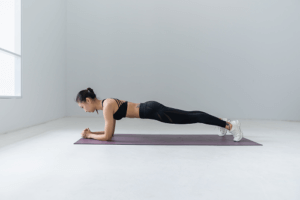
5. Plank (Front or Side)
– 3 sets × 30–45 seconds
– Keep your body in a straight line, brace your core as if bracing for a punch. For lower ab emphasis, check out the lower abs exercise guide.
Workout C (Fridays)
1. Sumo Squat
– 3 sets × 12 reps
– Wide stance, toes pointed outward at 45°. Targets inner thighs and glutes differently than a standard squat.
2. Pike Push-Up (Shoulder Focus)
– 3 sets × 8–10 reps
– Start in downward dog position, bend elbows to lower your head toward the floor, then press back up. Develops shoulder and upper back strength.
3. Single-Leg Romanian Deadlift
– 2 sets × 8 reps each leg
– Balance on one leg, hinge forward with a flat back, lower your opposite leg behind you. Excellent for balance, hamstrings, and glute strength.
4. Tricep Dip (Using a Chair)
– 3 sets × 10–12 reps
– Hands on a sturdy chair behind you, lower your body down and press back up.
5. Bird-Dog (Core Stability)
– 3 sets × 10 reps each side
– On hands and knees, extend one arm and the opposite leg simultaneously. Hold 2 seconds at the top before returning.
Progressive Overload: The Key to Continued Results
The single most important principle in strength training is progressive overload — consistently making your workouts slightly harder over time. Without progression, your body adapts and results plateau.
There are several ways to progress:
– Add reps: If you can complete 3 sets of 15 easily, aim for 3 sets of 17 next session.
– Add sets: Move from 3 sets to 4 sets of key exercises.
– Add load: Introduce resistance bands, dumbbells, or a loaded backpack.
– Increase time under tension: Slow down the lowering phase of an exercise (e.g., 3-second descent on a squat).
Track your workouts in a simple notebook or phone app. Knowing you did 3 × 12 squats last session creates a clear target for this session.
What to Eat to Support Strength Training
Strength training places different nutritional demands on your body than cardio. The key priorities:
Protein: Muscle protein synthesis requires adequate protein — aim for 0.7–1 gram of protein per pound of bodyweight per day. For a 140-pound woman, that’s 98–140 grams of protein daily. Sources include chicken, Greek yogurt, eggs, lentils, tofu, and cottage cheese.
Timing: Eating protein within 2 hours after a workout accelerates muscle repair. A post-workout snack of Greek yogurt and fruit or eggs on toast works well.
Caloric context: If fat loss is the goal, you need a modest caloric deficit — but too large a deficit impairs muscle development. Aim for a 200–300 calorie daily deficit rather than aggressive restriction.

FAQ: Strength Training for Women
Q: Will strength training make me bulky?
A: No — this is the most persistent myth in women’s fitness. Building substantial muscle mass requires a large caloric surplus, very high training volumes, and (in men) significantly higher testosterone levels than women produce. Consistent strength training will make you leaner, more defined, and stronger, not larger.
Q: How long before I see results from strength training?
A: Most women notice strength improvements (lifting more, doing more reps) within 2–3 weeks. Visible body composition changes typically appear at 6–8 weeks with consistent training and adequate protein intake. Significant recomposition usually takes 12–16 weeks. Patience and consistency are the real variables.
Q: Can I strength train during my period?
A: Yes, and for many women, training through their cycle is fine. Some research suggests strength output may peak during the follicular phase (days 1–13) due to estrogen’s positive effect on muscle recovery. During the luteal phase (days 14–28), you may feel more fatigued — listen to your body and reduce intensity if needed.
Q: Is bodyweight training as effective as weights for women?
A: For beginners and intermediates, absolutely. Bodyweight training builds genuine strength and creates the muscle stimulation needed for body composition changes. As you advance, external resistance (bands, dumbbells, barbells) allows for greater progressive overload and continued gains.
Q: Should women strength train differently than men?
A: The foundational training principles are identical. Women may benefit from higher training volumes (more sets per muscle group) due to faster muscle recovery. The key difference is contextual — some women need to overcome psychological barriers around lifting heavy, while the biology is the same.
Conclusion
Strength training is not just for athletes, bodybuilders, or people who already look fit. It is, arguably, the single most valuable form of exercise for women across every measure that matters: body composition, bone health, metabolic rate, hormonal balance, mental health, and longevity.
The three biggest takeaways from this guide: you will not get bulky from strength training; two to three sessions per week is enough to see real results; and progressive overload — consistently making your training slightly harder — is the mechanism that drives continuous improvement.
Your action step this week: complete Workout A from this guide. Just one session. See how you feel afterward — the combination of effort and accomplishment is something most women find immediately motivating. Then schedule your second session two days later.
Building strength is a long game. But every single session moves the needle. Start this week, and by July your body — and your confidence — will reflect exactly how much work you’ve put in.
For more ways to build a complete home fitness routine, explore the home workout guide at fittheories.com.