7 Best Yoga Poses for Stress Relief (Science-Backed Guide)
Chronic stress has become a defining feature of modern adult life — and the body keeps score. Elevated cortisol levels disrupt sleep, impair digestion, weaken immune function, and accelerate physical fatigue. Yet most stress-management advice focuses on mindset shifts or breathing exercises in isolation. Yoga poses for stress relief works differently: it addresses the physiological stress response directly, training the nervous system to shift from sympathetic overdrive into parasympathetic recovery.
Research published in Harvard Health confirms that a consistent yoga practice increases levels of GABA (gamma-aminobutyric acid), the brain’s primary calming neurotransmitter, while simultaneously reducing circulating cortisol. You do not need to be flexible, experienced, or own expensive equipment. The seven poses in this guide require only a mat and 20 minutes — and their effects on your stress levels are measurable from the first session.
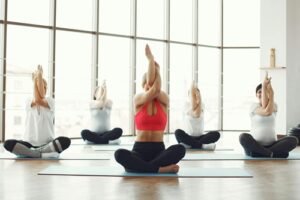
How Yoga Reduces Stress Physiologically
Before exploring specific poses, it is worth understanding the mechanism. Stress activates the hypothalamic-pituitary-adrenal (HPA) axis, flooding the bloodstream with cortisol and adrenaline. This is appropriate for short-term threats — but when the stress response stays active for weeks or months, it becomes corrosive.
Yoga for stress relief interrupts this cycle through three pathways:
Controlled breathing (pranayama): Slow, diaphragmatic breathing directly activates the vagus nerve, which signals the parasympathetic nervous system to initiate the relaxation response. Even without poses, studies on breath-focused yoga show measurable reductions in perceived stress within four weeks.
Physical movement: Gentle yoga postures release muscular tension stored in the hips, shoulders, and jaw — areas where the body habitually guards against perceived threats.
Mindful attention: Holding poses with focused awareness interrupts rumination cycles, giving the prefrontal cortex a break from the stress-generating loop of worry and anticipation.
For a broader look at how physical activity and mental health interact, see our guide on mental health and physical health.
7 Yoga Poses for Stress Relief
These poses are sequenced intentionally: they begin with gentle grounding, progress through deeper release, and conclude with full nervous system recovery.
1. Child’s Pose (Balasana)
Child’s Pose is the foundational yoga pose for stress relief. The forward fold compresses the abdomen gently, stimulating the vagus nerve while the forehead resting on the mat activates the parasympathetic frontal lobe reflex.
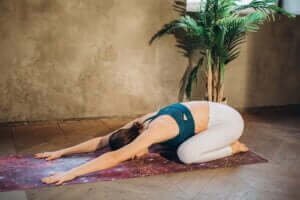
How to perform it:
– Begin on hands and knees, toes together, knees hip-width apart
– Sink your hips back toward your heels
– Extend your arms forward along the mat or rest them alongside your body
– Allow your forehead to rest on the mat
– Hold for 60–90 seconds, breathing slowly and deeply through the nose
What you will feel: An immediate softening in the lower back and hips. Many practitioners notice their breathing naturally slows within 30 seconds.
Modification: Place a folded blanket under the knees if hip flexibility is limited.
2. Cat-Cow Stretch (Marjaryasana-Bitilasana)
This dynamic spinal flow serves as a yoga pose for stress relief by warming the spine and synchronizing breath with movement — the key combination that shifts the nervous system toward parasympathetic activation.
How to perform it:
– Begin on hands and knees in a neutral tabletop position
– On an inhale, drop the belly toward the floor, lift the head and tailbone (Cow)
– On an exhale, round the spine toward the ceiling, tuck the chin and tailbone (Cat)
– Continue for 8–10 breath cycles, letting the movement be led by the breath
What you will feel: A gradual release of tension across the thoracic spine — the area most compressed by desk posture and stress-related guarding.
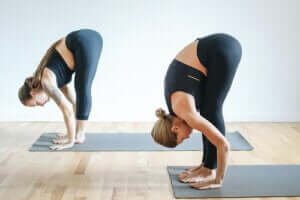
3. Standing Forward Fold (Uttanasana)
Inversions and semi-inversions are powerful yoga poses for stress relief because they shift blood flow toward the brain’s calming centers and reverse the physical tension pattern of stress — which typically manifests as raised shoulders and a compressed chest.
How to perform it:
– Stand with feet hip-width apart
– Exhale and hinge at the hips, folding forward
– Allow your upper body to hang completely — do not attempt to “reach” the floor
– Bend the knees generously if hamstrings are tight
– Hold for 30–60 seconds, nodding the head gently to release the neck
– Rise slowly, stacking one vertebra at a time
What you will feel: A decompression of the lumbar spine and a notable quieting of mental chatter. The inverted position lowers heart rate measurably in most people.
4. Seated Forward Fold (Paschimottanasana)
This seated yoga pose for stress relief targets the hamstrings and lower back while the folded position naturally encourages internal focus — redirecting attention away from external stressors.
How to perform it:
– Sit on the floor with legs extended straight in front of you
– Inhale and lengthen the spine
– Exhale and hinge forward from the hips, reaching toward your feet (use a strap or towel if needed)
– Do not force depth — the goal is spinal length, not touching the toes
– Hold for 60–90 seconds with slow nasal breathing
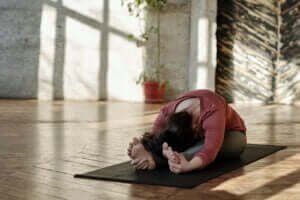
What you will feel: Progressive release in the posterior chain, combined with a meditative quality that deepens with each exhale.
Modification: Sit on a folded blanket to tilt the pelvis forward if the lower back rounds severely.
5. Supine Spinal Twist (Supta Matsyendrasana)
Spinal twists are among the most effective yoga poses for stress relief because they decompress the vertebral discs, stimulate digestion (which is impaired by chronic stress), and create a wringing-out effect on the abdominal organs that dissipates physical tension.
How to perform it:
– Lie flat on your back
– Draw the right knee into the chest, then guide it across the body toward the left side of the mat
– Extend the right arm straight out to the side, palm facing up
– Look toward the right hand or keep the gaze at the ceiling
– Hold for 60–90 seconds, then repeat on the other side
What you will feel: An opening across the outer hip and a release in the mid-back. Many people experience an audible or felt “release” in the thoracic spine.
6. Legs-Up-the-Wall Pose (Viparita Karani)
This restorative yoga pose for stress relief is one of the most evidence-supported postures for nervous system recovery. The passive inversion lowers heart rate, reduces lower-limb swelling, and triggers the relaxation response without any muscular effort.
How to perform it:
– Sit sideways against a wall, then swing your legs up the wall as you lower your back to the floor
– Your hips should be as close to the wall as comfortable
– Arms rest by your sides, palms facing up
– Close your eyes and breathe naturally
– Hold for 3–5 minutes
What you will feel: A profound heaviness and warmth in the legs as venous blood returns toward the core. Most practitioners report a meditative stillness that is difficult to achieve in seated positions.
Note: This pose is particularly useful as an evening wind-down practice for those whose stress manifests as sleep disruption.
7. Corpse Pose (Savasana)
Savasana is the final and arguably most important yoga pose for stress relief in any sequence. It is often underestimated because it appears passive — but the nervous system integration that occurs during full conscious rest is where the cumulative benefit of the preceding poses is absorbed.
How to perform it:
– Lie flat on your back, feet slightly wider than hip-width, toes falling naturally outward
– Arms rest a few inches from the body, palms facing up
– Close your eyes and allow your body to feel completely heavy
– Maintain wakefulness while releasing all muscular control
– Hold for 5–10 minutes
What you will feel: A distinct shift in mental state — the transition from active thinking to a diffuse, restful awareness. If you fall asleep, the practice is still beneficial.
How Often Should You Practice Yoga for Stress Relief?
According to ACE Fitness, stress-reduction benefits from yoga are cumulative — meaning consistent short sessions outperform occasional long ones. The research-supported minimum is two to three sessions per week of 20–30 minutes each.
For those new to the practice, starting with three sessions per week of the sequence above and progressing to daily shorter practices (10–15 minutes) produces measurable cortisol reduction within four to six weeks.
For a foundational overview of additional yoga benefits and a detailed pose reference for beginners, explore our complete guide to yoga poses for beginners.
What Type of Yoga Is Best for Stress Relief?
Not all yoga styles address stress equally. The most effective styles for stress relief are:
Hatha yoga: Slow-paced, with sustained holds and strong emphasis on breath. Ideal for beginners and for anyone whose stress manifests as physical tension.
Restorative yoga: Uses props (blankets, bolsters, blocks) to support the body in passive poses for extended durations. The most directly parasympathetic-activating style.
Yoga Nidra: A guided meditation practice performed in Savasana. Clinical studies show 11-minute sessions can produce rest equivalent to several hours of sleep. Highly recommended for stress-related insomnia.
Yin yoga: Targets connective tissue and fascia through long holds (3–5 minutes per pose). Excellent for releasing deep-seated physical tension.
Avoid hot yoga (Bikram) or power yoga as primary stress-relief tools — the physical demands of these styles can temporarily elevate rather than reduce cortisol.
FAQ: Yoga for Stress Relief
Can yoga for stress relief help with anxiety?
Yes. Multiple clinical studies show that regular yoga practice reduces self-reported anxiety and lowers physiological markers of stress including heart rate variability and salivary cortisol. However, yoga is a complement to, not a replacement for, professional mental health support when anxiety is clinically significant.
How quickly does yoga reduce stress?
Most practitioners notice an immediate calming effect after a single session, particularly with restorative styles. Sustained reductions in baseline stress levels — measurable via cortisol testing — typically emerge after four to eight weeks of consistent practice.
Is 20 minutes of yoga enough for stress relief?
Yes. Research supports that 20-minute sessions are sufficient to activate the parasympathetic nervous system and produce measurable reductions in perceived stress, particularly when the practice includes pranayama (breath work) and a full Savasana.
Should I practice yoga for stress relief in the morning or evening?
Both are effective. Morning practice primes the nervous system for a calmer stress response throughout the day. Evening practice — particularly Legs-Up-the-Wall and Savasana — accelerates sleep onset and improves sleep quality, which directly reduces next-day stress levels.
Can beginners benefit from yoga for stress relief?
Absolutely. The poses described in this guide require no prior experience. The stress-relief benefits of yoga are not contingent on flexibility or advanced technique — they arise from the breath-movement connection, which is accessible from the first session.
What if I cannot quiet my mind during yoga?
This is normal and expected. The goal of yoga for stress relief is not to stop thinking — it is to observe thoughts without engaging them. With practice, the gap between thoughts lengthens naturally. Focusing on the physical sensations of each pose is the most effective way to redirect attention.
Conclusion
The seven yoga poses for stress relief in this guide work because they address stress at the physiological level — not through willpower or distraction, but by directly activating the parasympathetic nervous system and reducing cortisol. The key takeaways are:
- Yoga for stress relief is most effective when practiced consistently at a moderate intensity — two to three sessions per week minimum.
- The sequence of Child’s Pose → Cat-Cow → Forward Folds → Spinal Twist → Legs-Up-the-Wall → Savasana creates a complete nervous system reset in under 25 minutes.
- Breath is the mechanism — slow nasal exhalations during each pose amplify the calming effect significantly.
Your next step: practice this sequence tonight. Place the mat before you begin your evening routine — the barrier to starting is the only real obstacle.
For more foundational guidance, explore our complete resource on yoga poses for beginners.
Consult a qualified fitness professional before making significant changes to your routine.