7 Walking Yoga Techniques to Boost Fitness and Calm Your Mind
Search interest in walking yoga has grown by more than 2,400 percent in the past year alone — a figure that reflects a broader shift in how people think about exercise. The high-intensity, sweat-soaked workout model is giving way to something more sustainable: movement that is genuinely enjoyable, accessible to all fitness levels, and capable of addressing both physical and mental health simultaneously.
Walking yoga is exactly that. It takes the foundational principles of yoga — conscious breathing, body awareness, and intentional movement — and integrates them into a walking routine. The result is a practice that builds cardiovascular fitness, improves flexibility and joint mobility, and reduces stress, without requiring a studio, a mat, or any prior yoga experience.
According to the American College of Sports Medicine’s 2026 Fitness Trends report, mind-body practices that combine movement with breathwork are among the fastest-growing fitness categories globally. Walking yoga sits at the intersection of several of those trends simultaneously.

This guide covers seven specific walking yoga techniques — each one practical, progressive, and easy to implement on your next walk.
What Is Walking Yoga?
Walking yoga is a hybrid movement practice that weaves yoga principles into a walking routine. It is not simply yoga performed outdoors, nor is it a casual stroll. A walking yoga session typically alternates between brisk walking and standing yoga poses or breathwork sequences, integrating mindful awareness throughout.
Unlike studio yoga, walking yoga eliminates several barriers to entry: no mat, no membership, no flexibility prerequisite, no specific clothing. You need comfortable shoes and a walking surface — pavement, a park path, or a treadmill all work equally well.
The physical benefits are well documented. Harvard Health Publishing has long recognized walking as one of the most effective and sustainable forms of cardiovascular exercise. Adding yoga elements extends those benefits into mobility, balance, and stress regulation.
Who Is Walking Yoga Best For?
Walking yoga is particularly well suited for people who find static yoga classes intimidating, those recovering from high-intensity training phases, individuals managing chronic low-level stress or anxiety, and anyone who wants to build or maintain fitness without formal gym access. Beginners should not be deterred — the practice scales to any fitness or flexibility level.
7 Walking Yoga Techniques to Practice
Technique 1: Rhythmic Breath Walking
This is the foundation of all walking yoga practice. Rhythmic breath walking synchronizes your breathing pattern with your footsteps, which activates the parasympathetic nervous system and reduces physiological stress markers.
How to do it: Walk at a comfortable pace. Inhale for four steps, exhale for four steps. Once that feels natural, try a 4-2-4 pattern: four steps inhaling, two steps holding, four steps exhaling. Maintain this rhythm for five to ten minutes continuously.
Benefit: This walking yoga technique immediately lowers perceived exertion, improves focus, and sets the physiological tone for the rest of your session.
Technique 2: Walking Arm Flows
Most walking routines ignore the upper body entirely. Walking arm flows add a yoga-inspired upper body component that opens the chest, stretches the shoulders, and enhances thoracic mobility — the area of the spine most compromised by desk work.
How to do it: While walking at a moderate pace, extend both arms out to the sides at shoulder height. On an inhale, sweep them overhead and bring palms together. On an exhale, open the arms wide and lower to shoulder height. Repeat for 10 full cycles, then resume natural arm swing.
Benefit: Improves shoulder mobility, counters forward posture, and reinforces breath-to-movement synchronization — a hallmark of walking yoga.
Technique 3: Pause-and-Pose Intervals
This is the core structural technique of a walking yoga session. It alternates periods of brisk walking with standing yoga poses held at natural stopping points — a bench, a corner, a wide section of path.
How to do it: Walk briskly for three to five minutes. Pause and hold one of the following standing poses for 30 to 45 seconds:
– Tree Pose: Stand on one foot, press the sole of the other foot against the inner calf or thigh, hands at heart center or overhead
– Warrior I: Step one foot back, bend the front knee to 90 degrees, arms overhead
– Standing Crescent: Feet together, arms overhead, lean gently to one side
Return to brisk walking after each pose. Repeat four to six times per session.
Benefit: Builds lower body strength and balance, reinforces postural alignment, and elevates heart rate through the walking intervals — making pause-and-pose intervals the most fitness-intensive walking yoga technique in this guide.
For a deeper exploration of standing yoga poses, the yoga benefits guide at FitTheories covers posture, flexibility, and strength benefits in detail.
Technique 4: Mindful Footstrike Scanning
This technique is borrowed directly from yoga’s body scan meditation and applied to walking. It trains attention, improves proprioception (your body’s awareness of its position in space), and can reduce injury risk by drawing attention to imbalanced movement patterns.
How to do it: Without altering your pace, shift your attention entirely to the sensation of each footstrike — the heel contacting the ground, the weight rolling forward across the arch, and the toes pushing off. Notice whether your weight distributes evenly, whether one foot lands more heavily, and whether your stride feels symmetrical. Spend five minutes in this awareness before returning to rhythmic breathing.
Benefit: Unlike most walking yoga techniques, this one has no visible component. Its value is attentional and neurological — it builds the body-awareness capacity that underpins all yoga practice and reduces the risk of developing compensatory movement habits over time.
Technique 5: Forward Fold Recovery Breaks
Sustained cardiovascular movement tightens the hamstrings, calves, and hip flexors. Forward fold recovery breaks address this directly by inserting standing forward folds into the walking session as active recovery pauses.
How to do it: After every 10 minutes of walking, stop and perform a standing forward fold: feet hip-width apart, hinge at the hips, let the upper body hang. Bend your knees slightly if your hamstrings are tight. Hold for 30 to 60 seconds, breathing deeply. Slowly roll back up to standing before resuming your walk.
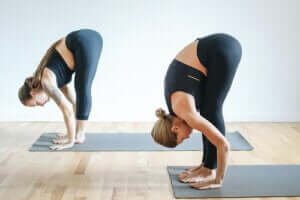
Benefit: Lengthens the posterior chain, decompresses the lumbar spine, and brings the heart rate down temporarily — making the subsequent walking interval feel significantly more manageable. This is one of the most practical walking yoga techniques for people with lower back tightness.
Technique 6: Lateral Lunge Intervals
Most walking is purely sagittal — forward and back. Lateral lunge intervals introduce frontal plane movement that strengthens the adductors, abductors, and glutes in planes of motion walking alone never reaches.
How to do it: Every five minutes, pause your walk and perform 10 slow lateral lunges per side. Stand with feet together, step wide to the right, bend the right knee, and lower your hips while keeping the left leg straight. Push back to center and repeat on the left. Keep your chest tall and your hips hinged slightly forward.
Benefit: Improves hip mobility, builds lateral stability, and activates the glutes and inner thighs — muscles that are chronically underused in forward-only movement. For those using walking yoga as part of a weight loss strategy, the yoga for weight loss guide at FitTheories provides complementary context on how movement volume and intensity affect body composition.
Technique 7: Closing Breathwork Cool-Down
Every walking yoga session should end with a structured breathwork cool-down rather than simply stopping movement. This signals the nervous system that the active phase is complete and supports recovery.
How to do it: For the final three to five minutes of your walk, slow your pace significantly. Begin box breathing: inhale for four counts, hold for four counts, exhale for four counts, hold for four counts. Repeat six to eight cycles. As you do, consciously relax your jaw, shoulders, and hands — areas that hold tension during active movement without awareness.
Benefit: Lowers heart rate systematically, reduces cortisol, and improves the quality of post-exercise recovery. Research on mindful walking and breath practices, including studies on university students cited in the Healthline walking yoga overview, consistently shows reduced anxiety and improved mindfulness scores following sessions that include structured breathwork.
How to Structure a Full Walking Yoga Session
A complete walking yoga session for beginners might look like this:
- Minutes 0–5: Rhythmic breath walking at an easy pace to establish the breath-movement connection
- Minutes 5–20: Walking with pause-and-pose intervals every 3–4 minutes; add walking arm flows during walking phases
- Minutes 20–30: Lateral lunge intervals and forward fold recovery breaks every 5–10 minutes
- Minutes 30–35: Mindful footstrike scanning as a transitional practice
- Minutes 35–40: Closing breathwork cool-down
Total time: 40 minutes. This can be shortened to 20–25 minutes for busier days by compressing the middle phase.
FAQ
Do I need any yoga experience to try walking yoga?
No. Walking yoga is specifically designed to be accessible to people with no yoga background. The standing poses used in the practice are beginner-level, and the breathwork techniques require no prior meditation experience.
How often should I practice walking yoga?
Three to four sessions per week is a practical starting point. Unlike high-intensity training, walking yoga places minimal stress on the joints and connective tissue, so recovery time is short. Some practitioners do it daily.
Can walking yoga help with weight loss?
Walking yoga contributes to calorie expenditure and, more significantly, builds the consistent movement habit that supports long-term weight management. It is particularly effective when combined with nutrition and resistance training.
What footwear is best for walking yoga?
Supportive walking shoes with a flexible sole work well. Avoid minimalist shoes with no cushioning until your feet have adapted to the lateral and balance demands of the standing poses.
Is walking yoga good for stress and anxiety?
Yes. The combination of rhythmic breathing, body awareness, and outdoor movement directly activates the parasympathetic nervous system. Multiple studies have found that mindful walking practices reduce state anxiety and improve overall mood.
Can I do walking yoga indoors?
Yes. A treadmill, a long hallway, or any open indoor space works for the walking phases. The pause-and-pose intervals require only enough room to extend your arms fully.
Conclusion
Walking yoga works because it solves a genuine problem: most people will not sustain exercise that feels like a chore. By layering breathwork, intentional movement, and mindful awareness into a walk, it makes physical activity something you look forward to rather than endure.
The seven techniques in this guide — from rhythmic breath walking to lateral lunge intervals and closing breathwork — give you a complete, structured practice you can start today. Begin with the first two or three techniques, master the breath-movement connection, and add the more complex elements over time.
The only equipment required is a willingness to pay attention. That is the essence of yoga — and it turns out, it travels exceptionally well.
For a broader overview of yoga’s evidence-based benefits, explore the yoga benefits guide at FitTheories.
Consult a qualified fitness professional before making significant changes to your routine.